
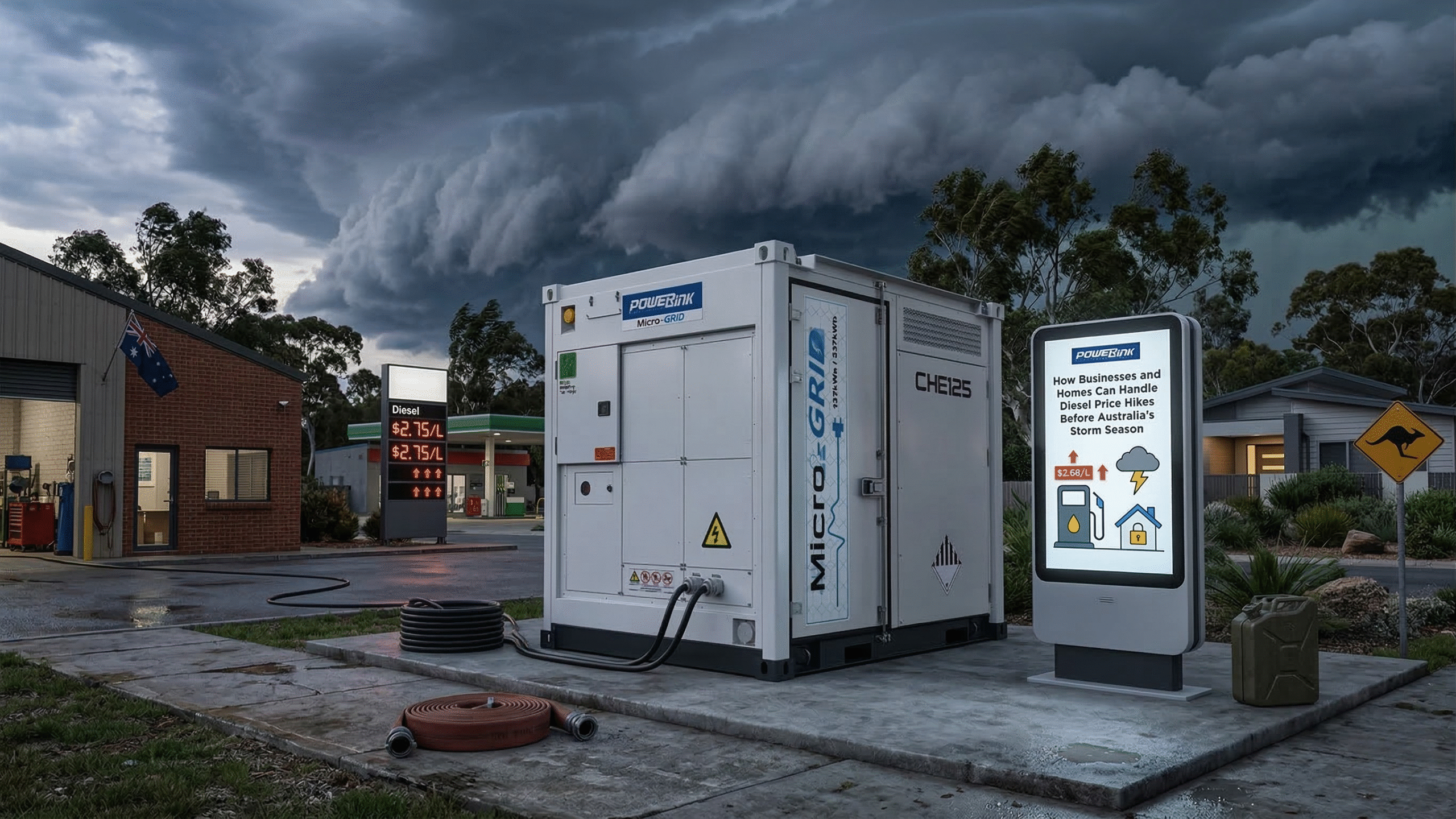
Australia is entering another storm season while facing rising diesel prices and energy uncertainty. For many businesses and households, this creates a double risk. Higher fuel costs increase operating expenses, and extreme weather raises the need for reliable backup power.
Recent data shows diesel prices have already surged to record levels, reaching up to $2.59 per litre in some regions (News.com.au). At the same time, Australia imports over 90% of its refined fuel, which makes prices highly sensitive to global disruptions (Climate Council). This combination exposes both businesses and residents to ongoing cost pressure.
This is where solar and Battery Energy Storage Systems, BESS, are becoming a practical solution.
Why Diesel Dependence Is Becoming Risky
Diesel generators have been the default backup solution for decades. They are reliable, but they come with increasing challenges:
- Fuel prices are volatile and can spike suddenly due to global events
- Logistics during storms can disrupt fuel supply
- Running generators continuously leads to high operational costs
In regional and remote areas, the impact is even higher because transport costs amplify fuel price increases (Discovery Alert).
For businesses that rely on uninterrupted power, such as construction sites, data centres, farms, and manufacturing units, this creates a serious financial and operational risk.
Storm Season Adds Another Layer of Pressure
Extreme weather events in Australia are becoming more frequent and intense. Recent years have seen cyclones, floods, and bushfires causing widespread outages (Energy Source & Distribution).
During storms:
- Grid power becomes unstable or unavailable
- Diesel demand spikes
- Fuel supply chains face delays
This creates a situation where relying only on diesel is both expensive and uncertain.
The Smarter Approach for long term solution : Diesel Generator + Solar + BESS
Along side diesel generator A hybrid energy system combining solar and battery storage and microgrid is now one of the most effective ways to manage both cost and reliability.
How it works
- Solar generates free energy during the day
- Batteries store excess energy
- Stored power is used during peak demand or outages
- Diesel generators run only when absolutely needed
This reduces fuel consumption significantly while improving energy security.
Battery systems also allow users to avoid high electricity prices during peak periods and even reduce grid dependency.
How BESS Reduces Fuel Costs
Battery Energy Storage Systems directly impact diesel usage in several ways:
- Store energy during low-cost periods and use it during peak demand
- Reduce generator runtime and fuel consumption
- Optimize load management and prevent energy waste
Studies show that integrating BESS with generators can significantly cut diesel consumption by optimizing when generators operate (Australian Energy Regulator (AER)).
Advanced energy management systems can reduce operational costs dramatically by balancing solar, battery, and generator usage in real time.
PowerLink BESS and Intelligent Energy Control
PowerLink’s BESS solutions are designed for Australian conditions where reliability and cost control are critical.
Key capabilities
1. Intelligent Management System, IMS
PowerLink integrates an advanced IMS that automatically switches between:
- Grid
- Solar
- Battery
- Diesel generator
This switching happens within milliseconds, ensuring continuous power supply without interruption.
2. Hybrid Optimization
The system prioritises solar and battery usage before activating diesel, which helps reduce fuel consumption and running hours.
3. Peak Shaving and Load Management
The system reduces peak demand by using stored energy, lowering both fuel and electricity costs.
4. Fast Response and Zero Outage
The system reacts instantly to changes in load or grid failure, ensuring uninterrupted operations during storms.
5. Scalable Design
Suitable for:
- Residential backup systems
- Commercial facilities
- Industrial and remote operations
Practical Strategies to Reduce Diesel Costs
For Businesses
- Shift to hybrid systems combining solar, BESS, and generators
- Use battery storage for peak shaving
- Reduce generator idle time with smart control systems
- Plan energy usage to maximise solar utilisation
For Households
- Install rooftop solar with battery storage
- Use stored energy during peak pricing hours
- Reduce reliance on diesel backup generators
- Prepare for outages with integrated backup systems
Why Now Is the Right Time
Fuel price shocks often accelerate the shift to alternative energy solutions (Discovery Alert). At the same time, Australia is investing heavily in battery storage and renewable energy infrastructure, making these solutions more accessible and effective.
Battery systems are also helping stabilise electricity prices by reducing reliance on expensive fuel-based generation during peak periods (ABC News).
Final Thought
Diesel will remain part of the energy mix, especially for backup. But relying on it alone is no longer cost-effective or reliable, especially during storm season.
A hybrid approach using solar and BESS offers:
- Lower fuel costs
- Better energy security
- Reduced exposure to global fuel price shocks
For both businesses and households, this shift is not just about sustainability. It is a practical way to manage costs and ensure reliable power in an uncertain energy environment.