
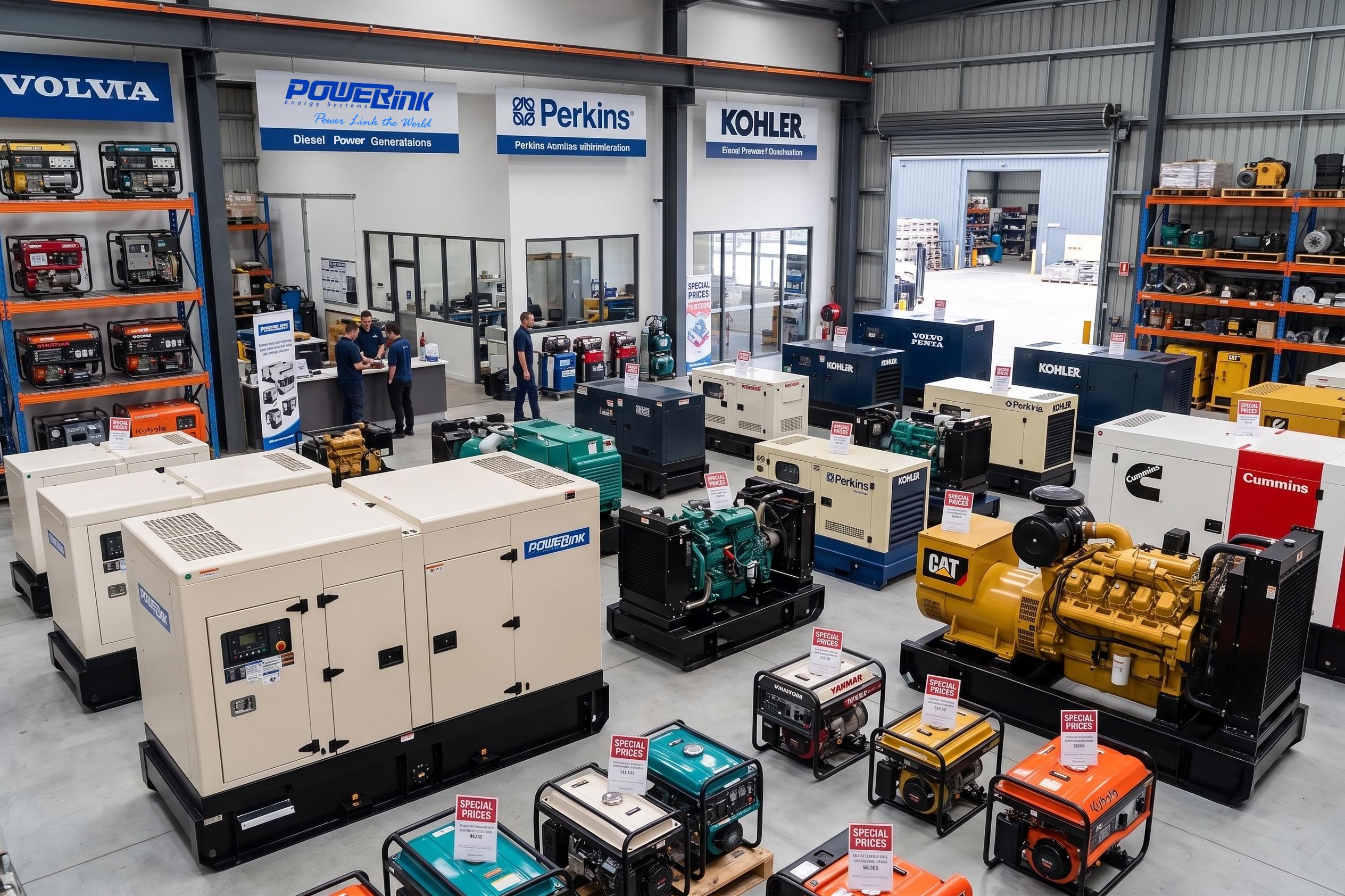
How to Size and Price a Commercial Diesel Generator for Your Business
Buying a diesel generator is a major capital investment, whether you need backup power for a home, job site, commercial building, or industrial facility. Price ranges vary significantly depending on total capacity, enclosure style, and most importantly the engine brand under the hood.
This updated diesel generator price guide breaks down expanded cost ranges, engine tier differences, and sizing principles so you can buy with confidence.
Diesel Generator Price Breakdown: Output & Engine Tiers
Diesel generator pricing ranges from under $2,000 for basic entry-level portable units to well over $500,000 for mega-watt class industrial power plants.
Below is an expanded price matrix categorizing capacity against engine market tiers:
| Generator Class | Capacity (kVA / kW) | Price Range (USD) | Common Engine Brands Used | Typical Applications |
| Small Standby / Portable | 5 kVA – 15 kVA | $1,800 – $12,000 | Yanmar, Kubota, Kohler, Hyundai, Gogopower | Homes, food trucks, small job sites, off-grid cabins |
| Light Commercial | 15 kVA – 50 kVA | $8,000 – $32,000 | Yanmar, Perkins, Cummins, Isuzu, Deutz | Small offices, retail stores, workshops, farms |
| Mid Commercial / Facilities | 50 kVA – 250 kVA | $22,000 – $110,000 | Perkins, Cummins, Volvo Penta, PowerLink, Caterpillar, John Deere | Supermarkets, hotels, construction sites, manufacturing |
| Heavy Industrial | 300 kVA – 1,000+ kVA | $85,000 – $500,000+ | PowerLink, Caterpillar (CAT), Cummins, MTU, Mitsubishi | Hospitals, data centers, mine sites, critical infrastructure |
Note on Installation Costs: Base generator prices exclude installation. Hardwiring, fuel storage setup, concrete pad construction, and local permits typically add 15% to 40% to total project outlay.
Main Factors That Drive Diesel Generator Prices
Two generators with the exact same power output can differ in price by tens of thousands of dollars. Understanding these price drivers helps you identify where to spend and where to save:
1. Open Frame vs. Sound-Attenuated Enclosure
- Open-Frame Sets: Cheaper option, designed for indoor generator rooms or enclosed trailers where noise isn’t an issue.
- Canopy / Acoustic Sets: Weatherproof, sound-attenuated enclosures reduce operating noise to manageable levels (typically 65–75 dBA at 7 meters). Adding a silent canopy usually increases base price by 15% to 30%.
2. Engine Brand and Component Quality
Premium engine manufacturers (such as Cummins, Perkins, Kubota, and PowerLink) command higher price tags due to proven reliability, long run-life, and widespread spare part availability. Budget engines reduce upfront purchase costs but may carry higher lifetime maintenance risks.

3. Automatic Transfer Switch (ATS) & Control Panels
An Automatic Transfer Switch (ATS) senses utility power failure and signals the generator to start and transfer the load automatically. Integrating an ATS adds $1,500 to $5,000+ depending on amperage ratings and system complexity.
4. Continuous vs. Standby Duty Rating
Prime / Continuous Rating: Built to serve as the primary power source for extended or round-the-clock operations. Prime sets use heavier-duty components and cost roughly 10% to 20% more than equivalent standby units.
Other Key Price Drivers
Standby Rating: Engineered to run during short utility outages (max 200–500 hours/year).
Beyond the engine brand, three major options adjust final unit pricing:
- Enclosure Type: An open-frame set (for indoor plant rooms) is the cheapest option. Adding a weather-proof, sound-attenuated “silent” canopy adds 15% to 30% to the base price.
- Automatic Transfer Switch (ATS): An ATS detects grid failure and auto-starts the generator. Adding an ATS costs $1,200 to $5,000+ depending on amperage.
- Duty Rating (Standby vs. Prime): Prime-rated units (built for continuous daily power) use heavier-duty alternators and cooling packages, costing 10% to 20% more than standby-only units.
Calculating the Right Generator Size Before Buying
Correct sizing prevents overpaying for capacity you don’t need—or under-sizing and risking engine failure.
Step 1: Total Your Continuous Load (kW)
        Add up running wattage for all simultaneous equipment.

Step 2: Calculate Motor Inrush / Surge
        Multiply electric motor starting loads by 3x to 5x.

Step 3: Convert to kVA & Add Safety Margin
        kVA = (Total kW / 0.8 Power Factor) + 20% Safety Headroom
Why Safety Headroom Matters
- Avoids “Wet Stacking”: Running a diesel engine below 30% capacity causes unburnt fuel to accumulate in the exhaust manifold, damaging engine components.
- Handles Inrush Currents: Heavy equipment (AC units, pumps, compressors) spikes voltage on startup. Adding 20% to 30% headroom prevents system trips.
New vs. Used Diesel Generators
If a new unit exceeds your capital budget, high-quality pre-owned equipment is an alternative:
- New Generators: Come with full manufacturer warranties (1–5 years), current EPA/EU emissions compliance, and zero runtime hours.
- Used / Low-Hour Standby Sets: Ex-hospital or ex-telecom standby units under 1,000 run-hours often sell for 30% to 60% below list price.
Ultimate Buyer Checklist
- Phase Requirement: Determine if you need Single-Phase (120V/240V) or Three-Phase (208V/415V) power.
- Noise Constraints: Check local council regulations to see if silent canopy ratings (<68 dBA) are required.
- Engine Support: Confirm local mechanics in your area can source filters and parts for your chosen engine brand.
- Total Cost of Ownership: Compare expected hourly fuel consumption alongside initial purchase price.
Need Expert Advice or a Customized Quote? Contact Powerlink Australia
Selecting the right generator for your specific power demands, site conditions, and budget requires expert technical guidance. Whether you need help sizing a system, selecting engine specifications, or configuring automatic transfer switches, the team at Powerlink Australia is ready to assist.
Get in touch with power generation specialists today for tailored consultations, technical specifications, and competitive pricing:
- Email: info@powerlinkenergy.com.au
- NSW Head Office: 6/113 Woodpark Rd, Smithfield NSW 2164 | Phone: (02) 8858 9688
- WA Branch Office: 1685 Albany Hwy, Kenwick WA 6107
- Website: powerlinkenergy.com.au